That time you misspelled “table” on a paper. That time you messed up a math problem while the smart kid sitting next to you muttered that it was “easy.” That time you sat down to take a test, and realized after glancing at the questions that you really should have studied for this one.
The American school system is having one of those moments. Said moment has now lasted for a span of several years. And it’s beginning to get embarrassing.
Thursday, March 6, 2014
Problems
Although we’ve more than doubled our spending on education in the last thirty-four years, NAEP reports that reading scores of students in the United States have stayed pretty much the same. From 1995 to 2009, our rate of improvement has been merely average.
Compared to the school systems of other developed countries, ours is the rich kid - the rich kid who’s been getting mysteriously poor grades.A standardized test given to 15-year-olds in several different countries ranked the United States 36th in Math, 25th in Reading, and 28th in Science. In all categories, we’re below the OECD average for developed countries - except in the category for average expenditure. We’re spending more money per student than most of the countries ranked above us for actual quality of education.
Causes . . .
So what are we doing wrong?

The “No Child Left Behind” policy has caught a lot of flak in recent years, in large part because of its emphasis (overemphasis?) on standardized testing. It’s been criticized as an unfairly one-size-fits-all method, and one that encourages teachers to “teach to the test” rather than trying to instill a love of learning.
But, as with any major problem, we can’t attribute the cause to only one single source.

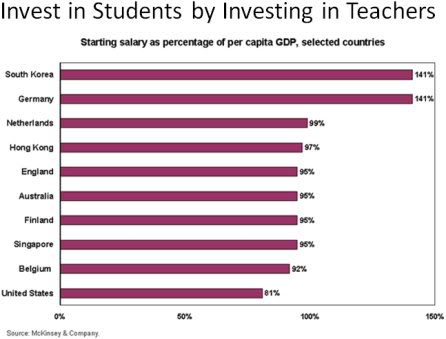
Hmmm . . . the nine other countries on that graph all pay their teachers more than we do. They are also all ranked high above us in math, reading, and science. We’ve spent a lot of time and effort throwing money at this problem to little effect; maybe it’s because we’ve been throwing it in the wrong direction.
Of course, cultural attitude has to have an impact as well.


These t-shirt designs for children are meant to be funny, but they reflect a sad truth about our country today: to be smart is, indeed, not considered cool. And that message leaks through to kids at a very young age. We can’t pin the tanking of our educational system only on institutions and policies; at some point, we have to recognize that we - the general American public - bear some of this blame, simply in the norms and attitudes that we uphold.
The “No Child Left Behind” policy has caught a lot of flak in recent years, in large part because of its emphasis (overemphasis?) on standardized testing. It’s been criticized as an unfairly one-size-fits-all method, and one that encourages teachers to “teach to the test” rather than trying to instill a love of learning.
But, as with any major problem, we can’t attribute the cause to only one single source.
Hmmm . . . the nine other countries on that graph all pay their teachers more than we do. They are also all ranked high above us in math, reading, and science. We’ve spent a lot of time and effort throwing money at this problem to little effect; maybe it’s because we’ve been throwing it in the wrong direction.
Of course, cultural attitude has to have an impact as well.
These t-shirt designs for children are meant to be funny, but they reflect a sad truth about our country today: to be smart is, indeed, not considered cool. And that message leaks through to kids at a very young age. We can’t pin the tanking of our educational system only on institutions and policies; at some point, we have to recognize that we - the general American public - bear some of this blame, simply in the norms and attitudes that we uphold.
Solutions?
How can we as a country begin to fix this?
Will it solve everything to get rid of No Child Left Behind? Will it only make things worse? Do we simply have to pour yet more money into our school system? Will that fix the problem?
It might be a good idea to look at what other countries, and other school systems, have been doing.
If we are willing to diversify our methods, we may find a solution to the problem of America’s lagging schools - a "formula," like Finland's, that can help our students thrive.
Subscribe to:
Posts (Atom)